Mittwoch, 9. Dezember 2015

03. – 07. December: San Pedro de Atacama and the countless „rutas del desierto“ around it…..

Again an early start on Thursday as it will be a long, hard day today: 420km to Calama, Chile, most of it either gravel road, "I-was-once-paved" or a so-called “carratera vichufita” (red earth, mixed with salt and water = hard as concrete); on the route 2 tiny villages and the border crossing. Fuel: no; other traffic: virtually none. So I'm pretty on my own and ‘m very aware of that circumstance. The originally planned route along the beautiful lagoons I skipped as Robin, the local motorcycle tour provider, had told me that it is even longer, with many sandy parts and no villages (or similar in between). Impossible, since I no longer have the tent with me – and in this case a stopover would have been necessary. Next to the fact that with my dualsport tires and my lack of sand-experience I just did not dare to take any risk. The weather as always here quite fresh in the morning but with bright sunshine I drive the first 50km or so towards Chile. The road first nice gravel but after I turn onto the Ruta 5 it changes to an energy-guzzling corrugated track. In these case normally more speed helps but as there had always been sandy parts in between and the “waves” partly quite deep I was forced to slow down. That’s an underground I really have to work on in the future! But after more than 30,000 trouble-free kilometers I just did not want to take the risk of an accident or damage the bike. After more than 150km of that corrugated gravel road the road turned onto a salt flat; this is great to drive but I was really happy to have my GPS with me as it was not always clear where the various car tracks actually lead. But here again a very impressive (ok, sometimes also a little queasy) feeling to drive on this Salar. Far and wide not a soul, no animals, no vehicles. Only the great Salar and me with my Suzy.


So I reach the border to Chile without any problems and see that this border is in the same time a freight border crossing for trains: as Bolivia has no sea port a part of the minerals - in that case copper - goes by train and via Chile into the rest of the world. The obligatory stamp in the passport, a small form to fill out and on the Chilean side then they checked whether I hide some fruits, plants or similar in my luggage. These first part of 220km took me almost 5 hours and as I was quite exhausted I made a short stop (with some water, nuts and Snickers) before driving on; meanwhile I had the chance to chatted with the train driver who had to wait at customs at the end of the lunch break. And so I could obtain information about the mining business firsthand ;-) 


Hardly on the Chilean side, a large part of the route was paved and the few gravel parts quite easy -passing small salt lakes, smoking volcanoes, many llamas and vicunas, just gorgeous. Needless to say, the whole time, of course always in bright sunshine. I even arrived early enough in Calama - the first city in Chile – to buy the necessary chip for my cell phone, a new power adapter (th eone I had with me had been stolen together with my trekking stuff) and get some Chilean Pesos. Besides that my Suzy finylla gets some "decent" gasoline, speak with an octane rating of at least. 95 instead of the Bolivian 81, 84. While it is all quite expensive in Chile (near Swiss level) the differences with Bolivia are immense: first the roads – for example it finally has road signs showing where the road leads -, the traffic behavior, friendliness of the people .... I feel home here straight away. Tired I book the nearest and cheapest – what is cheap in Chile - accommodation and go to sleep quickly. This day had definitely cost me a lot of energy –but it was a good day! And I’m aware that this is my last country on my trip! The next morning at breakfast coffee I speak quite a while with the owner. He tells me a lot about the economic situation, the immigration of workers and refugees (especially around the 1990 from Colombia) from the surrounding countries. Somehow very many similarities with Switzerland and Europe show up; but again impressive the way they try to make the best of the situation, rather than simply lamenting.
The trip to San Pedro de Atacama then short and painless: 100km on perfect asphalt ;-)
However the scenery just breathtaking again. The sight of the Atacama Desert is absolutely impressive. The colors mostly red-orange, interspersed with white spots. Several volcanoes dominate the mountain range; including the Licancabur (5920m) with one of the highest, lively crater lakes and the recently active Lascar. 
my camera has no chance to "catch" the immense desierto de atacama
volcan "Licancabur"
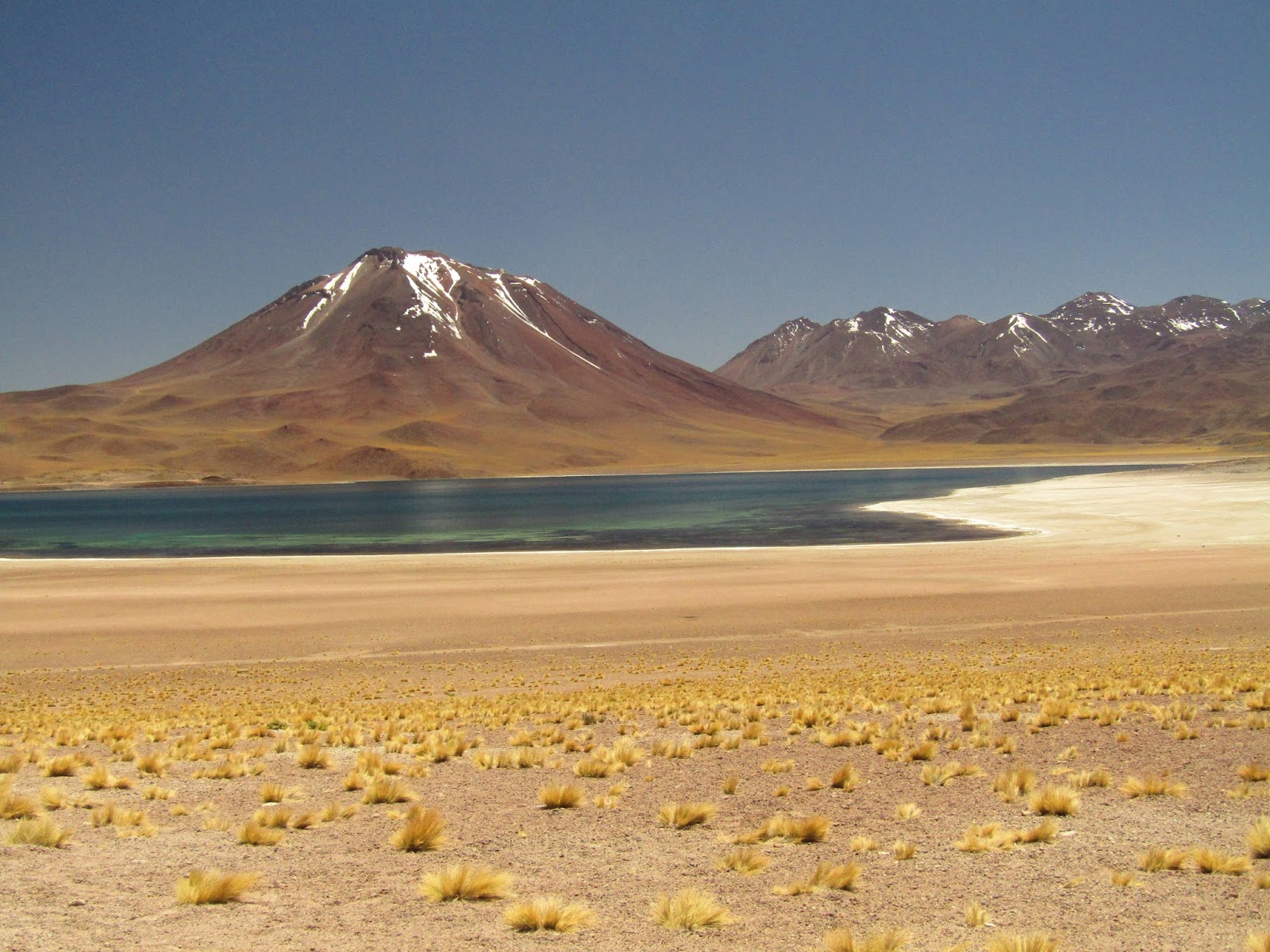
I will spend 3 nights in San Pedro and make day-trips to the surrounding  "rutas del desierto" around San Pedro; on the first day I even meet a Swiss motorcyclist pair; she is on the road since 4 months in South America (and will be another 4 months in the direction of Miami); he joined her for 2 months before work calls him back home. So we drive together towards the lagoons Miscanti & Miñiques - honestly, I defenitely go slow on superlatives.. too beautiful these landscapes - and after the lagoons I drive on to the pass Sico – while they drive back and visit the lagoon Cejar. 


lagoon Miscanti

In the evening we meet for supper in the village and it is nice to speak with some Swiss after such a long time. San Pedro is actually a small village with just about 5’000 inhabitants but is for some time now a popular starting point for 10'000 of tourists which start from there tours to the numerous salt lagoons, various valleys with impressive rock formations, geysers, multi-day tours to Bolivia and even volcano climbing. According to that fact San Pedro consists almost exclusively of restaurants, travel agencies, souvenir and small grocery stores. But at least it's built pretty; no modern or even tall buildings; just white houses in bungalow-style. In spite of all the tourists walking around feels quite nice.


The second day I drive in another direction towards the Argentinean border, to the "paso Jama" which leads to over 5000müM. It is freezing cold in the morning and I quarrel with myself that I have indeed put on the long-arm shirts but not the warm rain gloves! Again and again I stop; this time not only to make pictures but also to bring somehow back some life to my fingers. Thanks god, with the increasing sun the temperatures rise as well and so I spend my break shortly before the border in the sun, dozing and watching flamingos, vicunas and lamas. I just don’t get enough of this scenery and the infinity which the mountains show. It looks as if Chile could throw Colombia from the throne ;-)


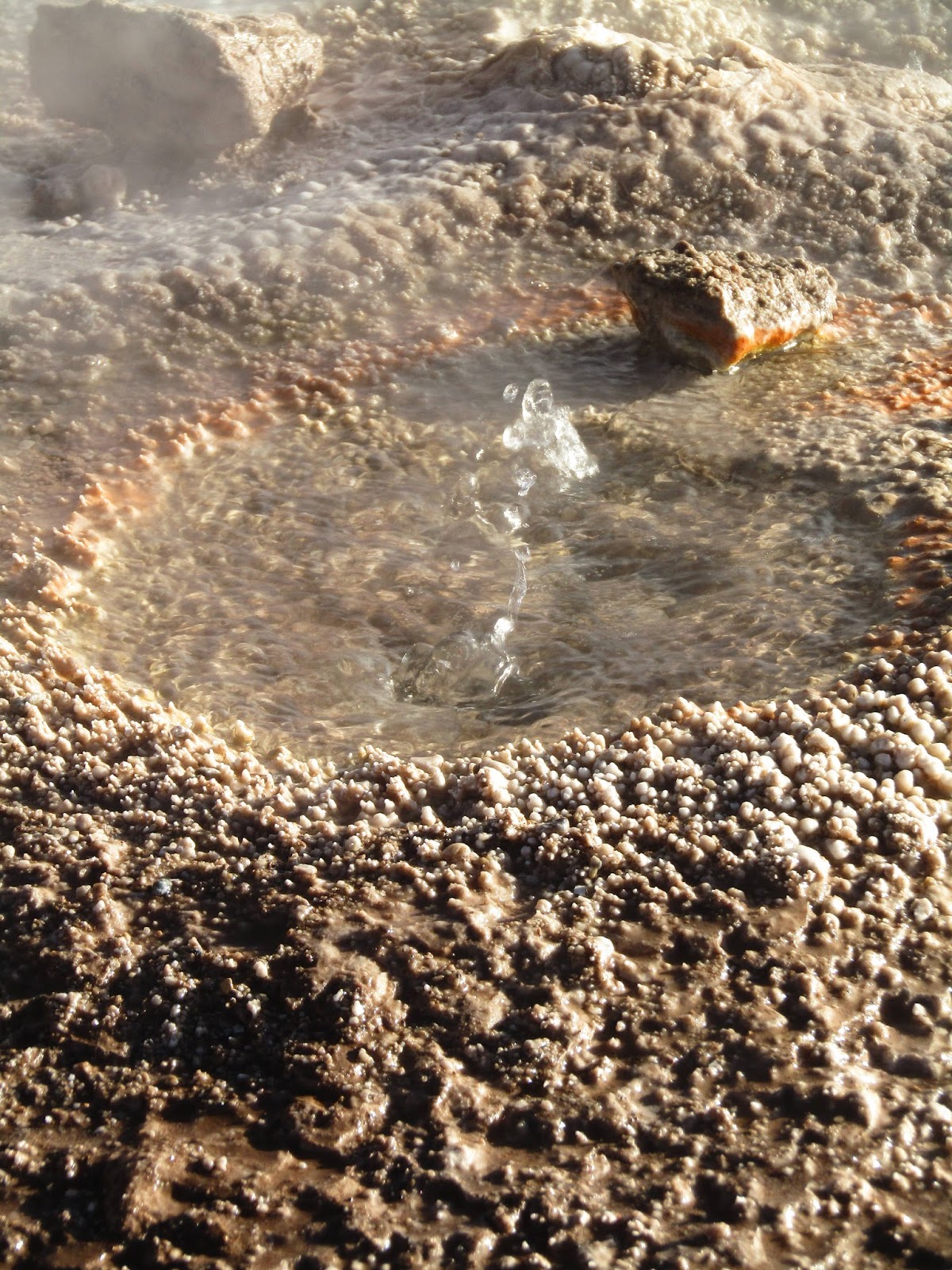
On the last day in San Pedro I’m already picked up at 4:30 clock; I booked a tour to the geysers; at a distance of 90km there is the highest, large geothermal field "el Tatio"; countless geysers spew more than 80 ° C hot water up to several meters high in the air. An impressive natural spectacle, of course especially just after sunrise when temperatures still be around freezing point – and at an altitude of  4200m. The immense temperature differences a typical desert phenomenon: during the day about 25 ° C, at night sinking depending on the month down to freezing.


So tomorrow I will leave San Pedro de Atacama with many incredible impressions and move for a change again towards the coast - Antofagasta will be my goal for the day. In theory, there are still around 1500 km to Santiago de Chile. But already one or other detour is still scheduled. And I'm already sure that I will enjoy every moment of my last days here…..;-)


Donnerstag, 3. Dezember 2015

23. November – 02. December: Peru for the last and Bolivia…. well, read and see for yourself…

Even though I actually wanted to leave on Monday Cusco, Alan, a local biker persuades me to stay another 1 or 2 nights. I can stay at his place and so have finally taken this opportunity to print my own stickers (an absolute "must" as an motorcyclists here in South America) and try to find out with a mechanic whats wrong with the fluid of the cooler system. Ira, Günter and Andres (a Chilean motorcyclists) are also still in Cusco and that makes my decision easy. Two cozy days and evenings, I even can make a short trip around the beautiful landscape around Cusco with Jorge and Tomas. Unfortunately even I get caught up with some bad luck after 5 months of travelling; during a visit of some Inca ruins one of the two luggage bag is cut open and the whole trekking stuff, among other things is stolen. Well, I've already made the trekking – so from now on there will be "only" motorcycling and no hiking anymore J That is part of the risk which I deal with so-called "soft luggage; I could secure the bags from not being stolen away from the bike but 100% safety's just not possible as the bags are soft and therefore not lockable.


On Wednesday at last I take off towards Bolivia; my last stop in Peru will be Puno which I reach quite late because I met 5 motorcyclists from Cusco on the way and spontanously join them them for a brief tour around some lakes just outside of Cusco. 


I didn’t miss much in Puno as there had been a big demonstration that day; people have demonstrated for cheaper water. Water is in these areas not self-evident and as it was getting more and more expensive they suddenly couldn’t hardly afford it anymore. For us unimaginable - but that happens when the municipalities sell the water resources to private companies and it therefore becomes part of speculating funds. The streets looked like after an earthquake: stones, entire boulders, much battered glass; the mood in the city was still quite "loaded". So I took the first payable hotel with a secure parking and left it again the next morning early, driving towards the border, always along the stunning Lake Titicaca.


It's almost a pleasure to pass the borders here, in comparison to the procedure with the border crossings in Central America. 


Thanks to the warning of Michael, who was on the Stahlratte with me and reached La Paz about 10 days earlier, I could avoid the traffic chaos in El Alto and reached in time the wonderfully secluded Camping Colibri, about 15km outside of La Paz. 3 nights in a cool teepee, magnificent views over the "Valley of Flowers" and the opposite mountains and the whole without honking and barking; simply pure nature. 


The next day I had to try to find spare parts as I had to replace sprockets and chain; Unfortunately, stupid enough I didn’t check them while still staying in Peru - stupidity is well known to be punished sooner or later. So that was no easy task in Bolivia as motorcycle parts Lucky that Andres had given me a bikers contact in La Paz and with the help of Marcelo and his "house-mechanic", chain and sprockets could actually be changed, although at a multiple of the price of Peru. While I waited on my motorcycle I strolled through La Paz, took one of the four cablecars that hover over the city. The construction of La Paz is truly special: the surrounding hills and valleys are totally blocked and so you are constantly walking on either steep up or steep down.


On Monday then on again towards Potosi, the famous silver mining town. As Ronaldo, the camping owner, had advised against the mountain route, as in very poor condition and with a number of defective bridges, I drove on the normal main road and made quite some kilometers. Thus, from the 2-day trip to Potosi it turned out to be one day and I reached Potosi tired from the long drive but still long before nightfall - Bolivia is back an hour and therefore sunset is an hour later ;-) Not very easy to find here an affordable hostel in this pulk of one-way tiny streets. After a 2-hour walk I had already seen enough; I confess here and now official that I just cannot do much with cities: beautiful main squares, 2,3 beautiful cathedrals and churches, beautiful colonial buildings - in the case of Potosi with funny, outstanding balconies. 


But that is more or less always the same in every city - ok, that's my personal opinion ;-). 
I enjoy the rides through the incredibly diverse and exciting landscapes much more, see the people in their - unfortunately mostly very poor- everyday life. While driving I can experience the country with all my senses – and I’m still not tired of driving - even after 5 months "on the road"!
So I leave Potosi the next morning already again, Uyuni and the famous salt lake is my aim now. I've considered to book a tour of the silver mine; but to see under what hard, inhuman, old conditions the mine people still have to work to earn a small living peril of their lives, I sort of didn’t want to see. During the trip - with hardly any traffic - the landscape changes slowly but surely to desert-like, barren. 


instead of yellow arrow-signs they just pile up stones and paint them in bright yellow :) 


Wherever a stream comes down from the mountains you can find right away trees and shrubs and all the llama herds romp in the meadows. This is currently THAT animal that crosses my way - literally - often right now ;-) I like the looks of them even if they stubbornly refuse to give me a great photo motif ... So here I am again and notice that I just love theses desert colors; and at the same time to know that I’m driving all the time somewhere between 3500-4000 meter, is simply fascinating - nota bene in sunshine and pleasant temperatures; only at night and in the morning it is quite fresh but for that I have my Goretex rainsuit that protects me as well from the cold as from the wind.


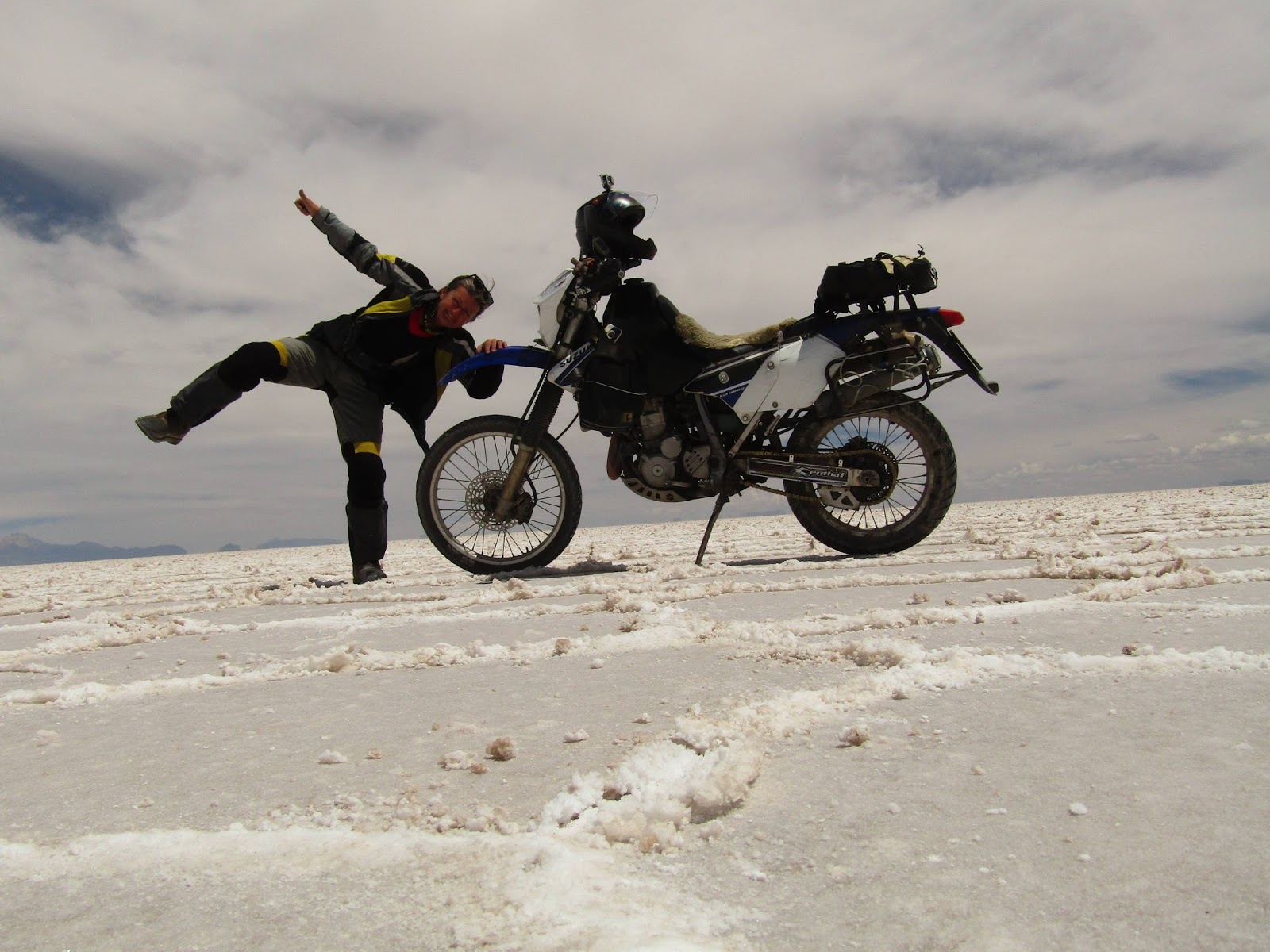
I reach Uyuni by early afternoon and have plenty of time to think about how I best check out the Salar. I take the easy way and call Robin, who offers guided motorbike tours on the Salar (of course not only) and we meet to discuss this together. Robin is a passionate motorcyclist and off-roader which moved to Bolivia because of his Bolivian wife. Together with a Bolivian he built up this company (www.motorcycletoursbolivia.com); He convinces me that I can make the tour on the salar easily on my own as the salar is dry as a bone right now and therefor easy to drive at the moment. He also offers me to get my bike washed at his place - an absolute necessity because the salt goes in anywhere and would be purely eat within a short time in everything. What a great opportunity to drive the salar with my Suzy istead of a hired bike. I start in the morning quite early as all the guided Jeep tours start only from 10 clock and I therefore have the Salar more or less just for me, at least the first 2 hours. Honestly, it's an incredible feeling to drive over the salt lake, resp. correctly "saltpan". You feel soooo small here, the salar infinitely great. 


I visit the salt hotel - really exciting since almost completely made of salt -, the lava island "Incuahasi" with up to 1,200 years old cacti on it, continue driving to the volcano Tunupa and watch there the caves with the – due to the high salinity  - four total well-preserved mummies; after that driving about the same way back to the mainland. I am traveling all day, driving alone on the salar more than 250km; rarely I have enjoyed a ride that much although theoretically totally boring as driving more or less always straight and on a white background all day. But the salar has a very special atmosphere from which I let myself be carried away.

built almost enterely out of salt

island "Incahuasi", in the middle of the salar
up to 1200 year old cacti, with sight from the island to the volcano
volcano Tunupa, 5432müM
one of the mummies in the grave on the way up to the volcano
 Back in Uyuni then Suzy is most thoroughly washed; instead of a payment I give Robin my big Swiss Army knife which he accepts very pleased because it will be a welcome aid on his tours. We chat for a long time on motorbikes, technique, everything that matches our topic: motorikes. And we talk as well about the Bolivians. He sort of can well understand that I do not really get "warm" with Bolivia – except of the breathtaking scenery. The Bolivians show a completely different atmosphere than any other South American people that I have experienced so far. Of course, I also met really nice and interested people here; but the majority of people seem somehow lethargic, not very interested in the tourists and a well-to-end business. The best example is the Herculean task to buy gasoline here in Bolivia ! The state has subsidized gasoline for the Bolivians and the service-station operator must therefore issue a separate receipt for the "foreigners" but he may also charge the triple. Many do not want to (or are able) to write these invoices/receipts and therefore refuse simply to sell gasoline to  people with international license plates; in areas where you don’t find a gas station every now and than quite tricky. Sometimes it works to say that I though paying the higher price of course do not require a separate bill - which of course would be financially an advantage for the petrol station operator. But even in large cities such as Potosi or Uyuni it may happen that you have to approach 3, 4 petrol stations until you get gasoline. Honestly, that’s just too much for me!! Even in Uyuni which is that proud to host the Dakar Rally - omnipresent at every turn - you would think that they handle it better. 


Far away from it: of 3 existing gasoline stations only ONE sells gasoline to foreigners – although that is officially of course not allowed. So I’ll have to buy for tomorrow  small extra can and fill it because I cannot take the risk not to get any gasoline  from the only gas station on the way to Chile.
such a receipt they should have to fill out for every foreigner!!
Today I just hang around in Uyuni – nothing but a pretty barren desert city - and prepare myself and Suzy for the long driving day. 

the view leaving my hotel
dozens of houses seem to be built right now - that leasts probably for years
of course also Uyuni with a nice main square ;-)

the famous train cemetery - left-overs from the silver-mining high season from 1900-1940 
Tomorrow I will therefore already be leaving Bolivia again and enter in my last country on 
this travel. It's not that I did not like Bolivia ; to spectacular the landscape but it is definitely not one of my "must - I - absolutely - re - visit countries ". The days are now counted, the 
more I 'm going to enjoy Chile and the totally different landscapes ( deserts, mountains , 
volcanoes , coast and sea ). My next destination: San Pedro de Atacama ; more of it in a 
few days :-)

Hasta luego, mi amigos